Home Security System
Overview
The Home Security Project is an end-to-end, AI-driven monitoring system built around an NVIDIA Jetson Nano that delivers real-time intrusion detection, identity recognition, and remote control—all for under $200 in hardware. Stereo CSI and ESP32-CAM modules capture video streams, while PIR sensors trigger motion-based alerts and guide active pan-tilt adjustments. On-board inference pipelines (MultiCue + YOLOv4-Tiny + dlib embeddings) classify individuals as Residents, Visitors, or Intruders, logging events locally and pushing snapshots and logs to Google Drive for off-site review. A companion mobile app (MIT App Inventor) provides live notifications, camera control, and event history, enabling homeowners to securely monitor and manage their property from anywhere.
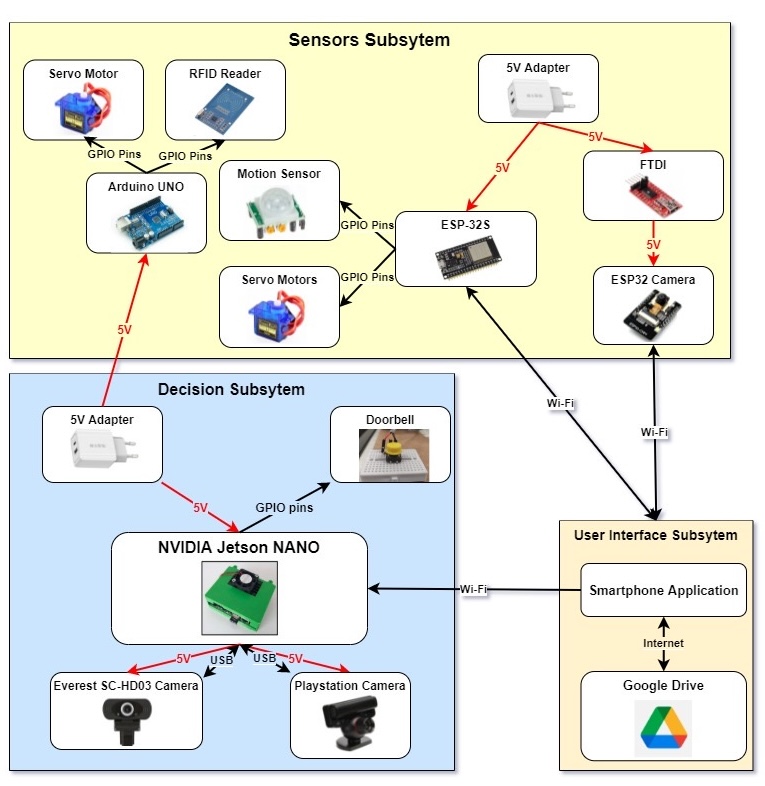
Components
Central Computer NVIDIA Jetson Nano Developer Kit (2 GB RAM) running all decision and inference algorithms
Wired Camera Raspberry Pi 4 CSI Camera Module (1080p @ 30 FPS) connected via the Jetson’s CSI port
Wireless Cameras Two ESP32-CAM modules (5 V, up to 10 m range) each mounted on a pan-tilt servo assembly for adjustable field-of-view
Motion Sensors Two HC-SR501 PIR sensors (7 m range, 120° detection cone) for motion triggering
Pan-Tilt & Servo Motors Hobby servos driven by ESP32-CAM GPIO for remote camera aiming
Subsystems
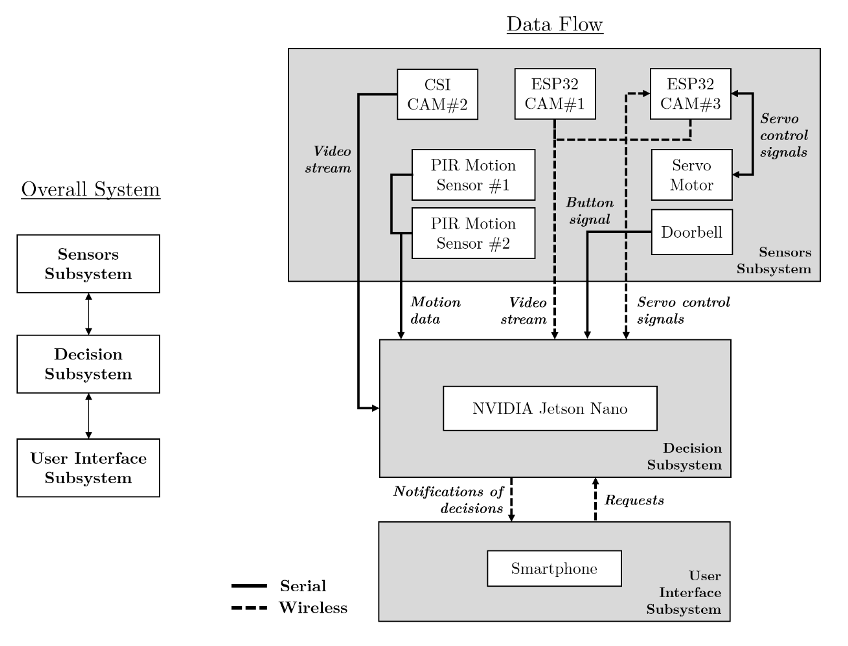
1. Sensor Subsystem
Acquires raw data from cameras and motion detectors:
Wired & Wireless Cameras capture live video streams.
- PIR Sensors detect movement and cue the cameras.
- Pan-Tilt Assembly (servos + brackets) enables active FOV control.
2. Decision Subsystem
Processes sensor inputs and classifies each event:
- Movement Detection via background-subtraction (MultiCue) to trigger heavier processing
- Object & Face Detection using YOLOv4-Tiny for real-time localization of humans and pets
- Face Recognition with dlib-based 128-dim embeddings (via face_recognition API) for identity matching
- Classification Logic implements flowchart rules to label Residents, Visitors, Suspects, and Intruders based on database matches and behavior patterns
- Database Management stores face encodings, timestamped entry logs, and snapshots in a local SQLite database
3. User Interface Subsystem
Allows residents to monitor, control, and review events:
- Mobile App built with MIT App Inventor provides:
- Real-time notifications of anomalies or intrusions
- Remote pan-tilt control of wireless cameras
- Log browsing and manual tagging of new faces
- Communication over the home’s common Wi-Fi network
4. Outer Structure Subsystem
Encloses and mounts all hardware:
- 3D-printed PLA Casings & Racks for Jetson Nano, CSI camera, ESP32-CAM platform, USB camera, and PIR sensors
- Designs produced in Catia and FreeCAD for weatherproofing and aesthetic integration
Technologies Used
Hardware: Jetson Nano, Raspberry Pi CSI Camera, ESP32-CAM, HC-SR501 PIR, hobby servos, FTDI.
Algorithms & Libraries: MultiCue BGS for motion detection; YOLOv4-Tiny for object/face detection; dlib & face_recognition for face matching.
Software & Tools: Python, OpenCV, NVIDIA TensorRT optimizations; MIT App Inventor.
Interfaces & Protocols: CSI, GPIO, UART; Wi-Fi networking. —
Connectivity & Remote Access
- Google Drive Integration A Python-based cloud storage automation module leverages the Google Drive API to upload captured snapshots, database backups, and event logs to a shared Drive folder—enabling off-site review and archival